If the melody is to remain in C major, it will be played
16 19 23 26 19 23 26 29 = E G B D G B D F
Alternatively, the new key may be set to A minor – one of several possibilities. In this case the melody will appear as:
16 20 23 26 20 23 26 30 = E G# B D G# B D F#
accompanied by chords of A minor.
The product is order dependent; for the same two motives:
7 11 14 17 x 9 12 = 16 19 20 23 23 26 26 29
7 becomes 7+9 7+12, 11 becomes 11+9 11+12, etc.
An example with unequal durations
The pitches get added, the durations are multiplied (as fractions. If you don't know what it means, shame on you!)
| 12
| 11
| 9
|
| 1/2
| 1/4
| 1/4
| lasting 1/1
|
| cross
|
|
Compute:
| 12+7
| 12+11
| 11+7
| 11+11
| 9+7
| 9+11
|
| 1/2 x 3/8
| 1/2 x 1/8
| 1/4 x 3/8
| 1/4 x 1/8
| 1/4 x 3/8
| 1/4 x 1/8
|
Result:
| 19
| 23
| 18
| 22
| 16
| 20
|
| 3/16
| 1/16
| 3/32
| 1/32
| 3/32
| 1/32
| lasting 1/2
|
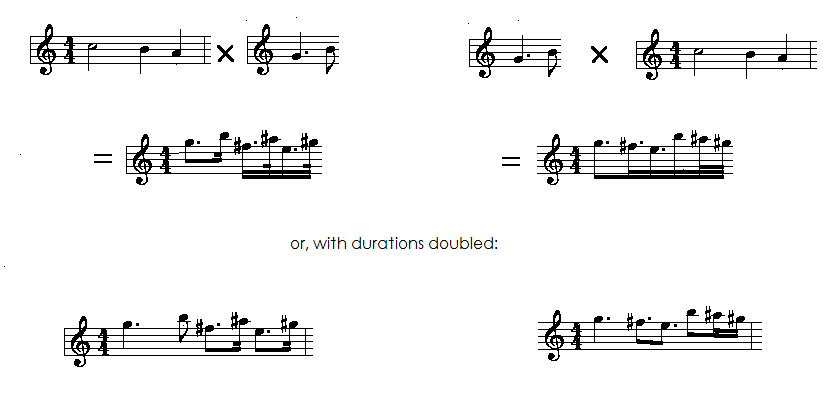
Notice the syncopated rhythm in the second product. Maybe should be smoothed to:

or even to
